
Maryam Nawaz E Bike Scheme Phase 2 Bike Specifications Detail 2026
Maryam Nawaz E Bike Scheme Phase 2 Bike Specifications
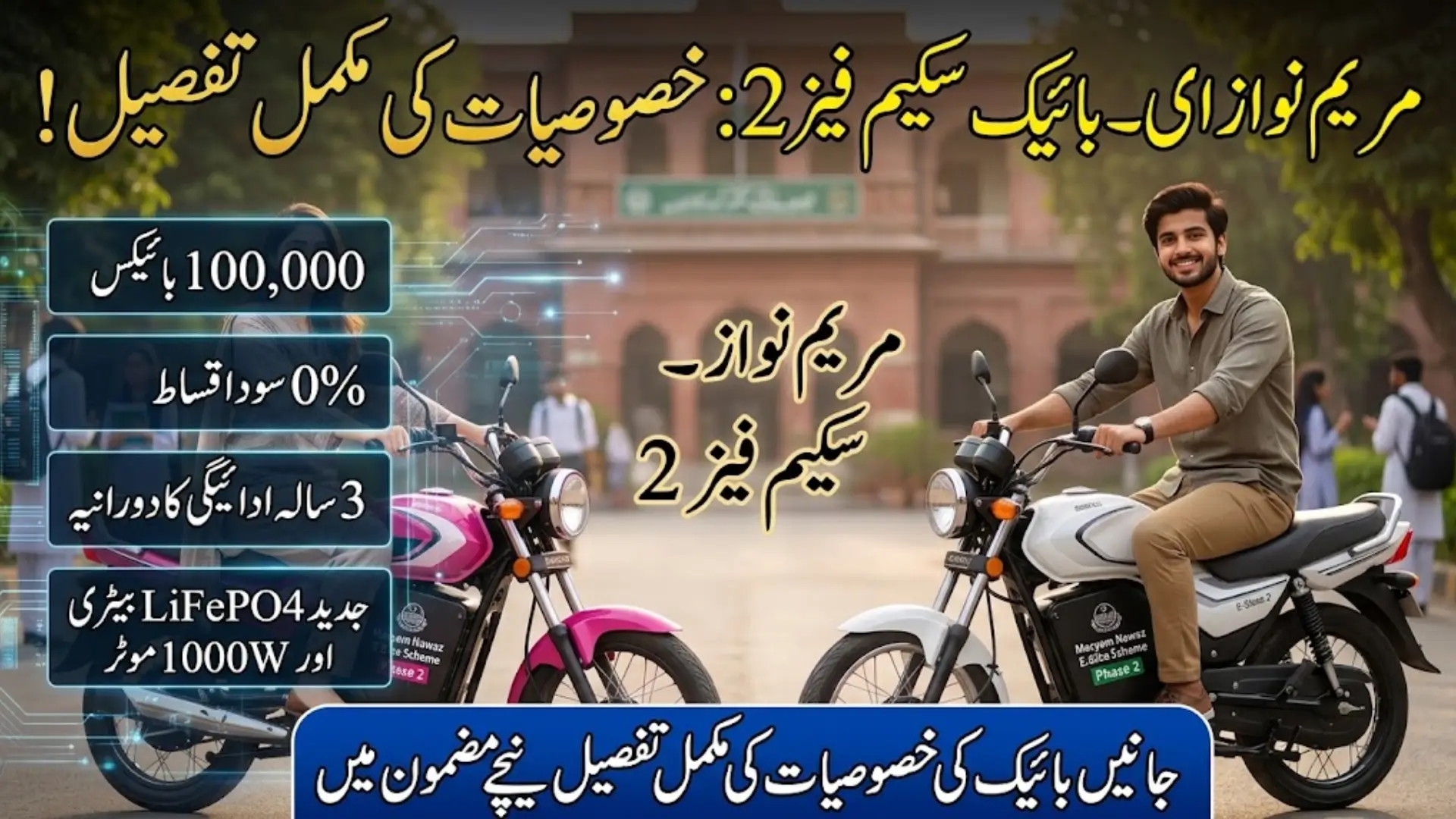
The initiative to provide electric bikes to students in Punjab under the Maryam Nawaz E-Bike Scheme Phase 2 is currently underway. This phase involves the provision of 100,000 e-bikes, with a system in place for students to acquire them through easy installments and government-facilitated terms.
Many students are keen to learn about the specifications of the bikes offered in Phase 2 specifically details regarding the battery, motor, speed, battery type, dashboard, and other features. This article outlines all the key specifications of the Phase 2 bike in simple terms.
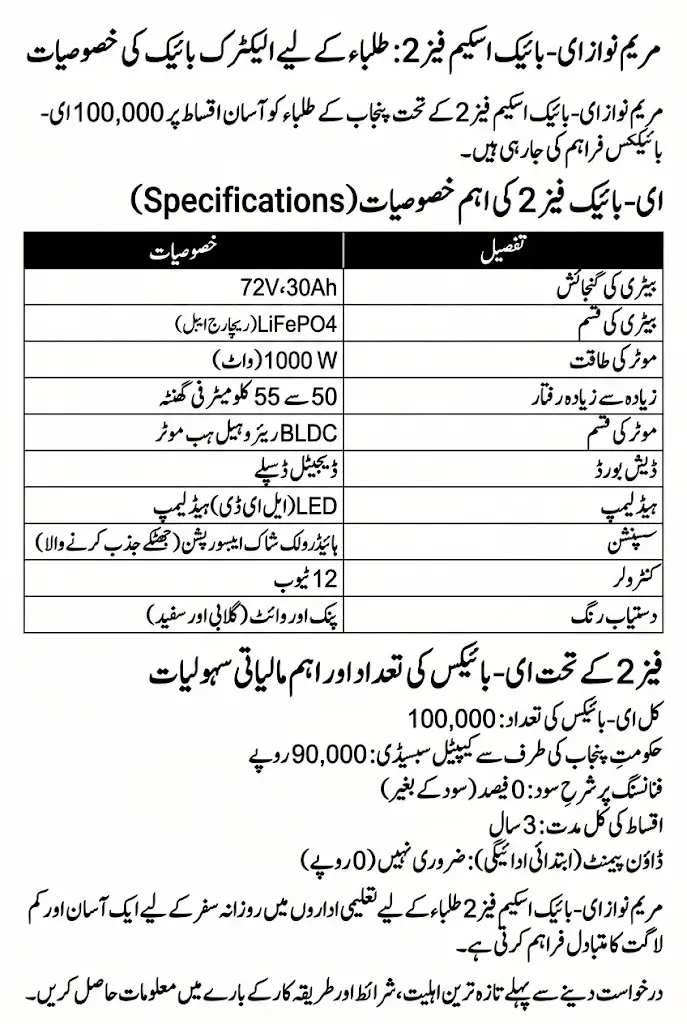
Maryam Nawaz E-Bike Scheme Phase 2 Specifications Overview
The key specifications of the Phase 2 E-Bike are as follows
| Specification | Details |
|---|---|
| Manufacturing Year | 2026 |
| Battery Capacity | 72V, 30Ah |
| Maximum Speed | 50–55 km/h |
| Motor Power | 1000 W |
| Battery Type | LiFePO4 |
| Dashboard | Digital Display |
| Controller | 12 Tube |
| Headlamp | LED |
| Suspension | Hydraulic Shock Absorption |
| Motor Type | BLDC Rear Wheel Hub Motor |
| Available Colors | Pink and Black |
Also Read: New Update! CM Punjab E-Bike Scheme Phase 2 Announces New Driving License Facility For Students
What is the E-Bike’s battery capacity?
The Phase 2 E-Bike is equipped with a 72V, 30Ah battery.
- This battery supplies electricity to the bike’s electric motor.
- It is an important component of the bike’s overall electrical system.
- 72V indicates the battery’s voltage.
- 30Ah refers to the battery’s capacity.
- The stored electrical energy is used to power the motor and drive the bike.
- The battery allows the bike to operate on electric power instead of a petrol engine.
- Battery capacity and condition can affect the bike’s overall performance.
- Proper charging and usage are important for maintaining battery performance.
According to the Phase 2 specifications, the 72V, 30Ah battery is the primary power source of the E-Bike.
What type of battery does the E-Bike use?
The Phase 2 E-Bike uses a LiFePO4 battery, which is a lithium-based rechargeable battery technology.
- LiFePO4 is a type of lithium-based rechargeable battery.
- It is used in electric vehicles and electric bikes.
- The battery stores electrical energy for the bike.
- This stored energy is supplied to the electric motor when needed.
- The battery can be recharged after use.
- It allows the E-Bike to operate using stored electrical power.
- The battery is an important part of the bike’s overall electrical system.
In simple terms, the Phase 2 E-Bike uses a rechargeable LiFePO4 battery system to store and supply power to the electric motor.
Also Read: CM E Bike Scheme 2026 Requirements And Necessary Documents For Application
What is the E-Bike’s maximum speed?
The Phase 2 E-Bike has a maximum speed of 50 to 55 km/h, meaning it can reach approximately this speed under suitable conditions.
- The maximum rated speed is 50–55 km/h.
- Actual speed may vary depending on road conditions.
- The rider’s weight can affect the bike’s performance and speed.
- Battery level and condition may also influence performance.
- Traffic and road conditions can require a lower riding speed.
- The maximum speed represents the bike’s capability, not a recommended constant riding speed.
- Riders should always choose a safe speed according to the road and traffic situation.
- All applicable traffic rules and designated speed limits should be followed.
In simple terms, the 50–55 km/h rating shows the maximum speed capability of the Phase 2 E-Bike under suitable conditions.
What is the motor power of the e-bike?
The Phase 2 E-Bike is equipped with a 1000-watt motor, which is one of the main components responsible for moving the bike.
- The motor converts electrical energy from the battery into movement.
- Its power rating is 1000 watts (1000W).
- The motor provides the power needed to drive the bike’s wheel.
- It works together with the battery to operate the E-Bike.
- Motor power is an important part of the bike’s overall performance.
- The motor helps the bike move and gain speed.
- The bike is powered by electricity rather than a petrol engine.
- The Phase 2 E-Bike uses this 1000W motor as its main source of driving power.
In simple terms, the 1000W motor uses electricity supplied by the battery to generate the power needed to move the E-Bike.
Which Type of Motor Is Used in the E-Bike?
The Phase 2 E-Bike uses a BLDC Rear-Wheel Hub Motor, which is an electric motor designed to power the bike’s rear wheel.
- BLDC stands for Brushless DC Motor.
- The motor is mounted inside the hub of the rear wheel.
- It receives electrical power from the bike’s battery.
- The motor converts electrical energy into mechanical movement.
- This movement rotates the rear wheel and moves the E-Bike forward.
- The rear-wheel hub design makes the motor an integrated part of the wheel.
- It is one of the key technical specifications of the Phase 2 E-Bike.
- The motor works together with the battery and controller to operate the bike.
In simple terms, the BLDC rear-wheel hub motor uses electricity from the battery to rotate the rear wheel and move the E-Bike.
What Is the Dashboard Like on the E-Bike?
The Phase 2 E-Bike comes with a Digital Display, which provides the rider with important information about the bike.
- The E-Bike uses a digital display instead of a traditional analog meter.
- The display presents bike-related information in an electronic format.
- It allows the rider to monitor relevant information while riding.
- Important indicators can be viewed directly on the dashboard.
- The digital format makes the information easy to read.
- It provides a convenient way to monitor the bike’s electrical system.
- Key information is presented together in one place.
- The dashboard is an important part of the E-Bike’s overall equipment.
In simple terms, the digital dashboard allows the rider to easily view important bike information while using the E-Bike.
What Kind of Headlamp Does the E-Bike Have?
The Phase 2 E-Bike is equipped with an LED Headlamp, which provides illumination at the front of the bike.
- The headlamp provides light in front of the E-Bike.
- It helps the rider see the road during low-light conditions.
- The LED lighting system is designed for forward illumination.
- It can be particularly useful when riding at night.
- Proper lighting can help the rider identify the road ahead.
- The headlamp also contributes to the bike’s visibility to other road users.
- Riders should use the headlamp appropriately during night travel.
- Safe riding practices and traffic rules should always be followed.
In simple terms, the LED headlamp helps illuminate the road ahead and improves visibility when riding in dark or low-light conditions.
What Is the E-Bike’s Suspension System Like?
The Phase 2 E-Bike features a Hydraulic Shock Absorption suspension system, which is designed to reduce the impact of shocks coming from the road.
- The suspension helps absorb shocks caused by uneven road surfaces.
- It can reduce the impact of potholes and bumps while riding.
- The hydraulic system is an important part of the bike’s suspension setup.
- It helps provide a smoother and more comfortable riding experience.
- The suspension can be useful when travelling on different types of roads.
- It helps minimize the effect of road shocks on the rider.
- This feature can be particularly useful for students who travel daily.
- Better shock absorption can make regular commuting more comfortable.
In simple terms, the hydraulic shock-absorption suspension helps reduce road shocks and provides greater comfort while riding the E-Bike.
What Type of Controller Is Used in the E-Bike?
The Phase 2 E-Bike is equipped with a 12-Tube Controller, which is an important electronic component of the bike’s electrical system.
- The controller helps manage the flow of electrical power from the battery to the motor.
- It regulates the power supplied to the electric motor.
- It works as a control unit between the battery and the motor.
- The controller plays an important role in the operation of the E-Bike’s electrical system.
- It helps provide the motor with the required electrical control.
- The controller works together with the battery and motor during operation.
- Proper control of electrical power is important for the bike’s overall operation.
- The Phase 2 specifications specifically list a 12-Tube Controller.
In simple terms, the 12-Tube Controller manages the electrical power supplied from the battery to the motor and helps control the bike’s electric system.
What Are the Color Options for the Maryam Nawaz E-Bike Phase 2?
The Phase 2 E-Bike is listed with Pink and White as the available color options. These two colors are included in the official specifications provided for the bikes under the scheme.
- Pink and White are the two colors listed for the Phase 2 E-Bike.
- Both color options are part of the bike specifications for the scheme.
- The available color may depend on the stock provided at the time of delivery.
- Applicants may not always be able to choose a specific color, depending on the scheme’s procedures.
- Color availability can vary based on the bikes available for distribution.
- Applicants should check the latest scheme information before applying if color selection is important to them.
- The final color provided may be subject to the applicable scheme process and availability.
In simple terms, the Phase 2 E-Bike is available in Pink and White, while the final color may depend on availability and the scheme’s applicable procedures.
How Many E-Bikes Will Be Provided in Phase 2?
The Maryam Nawaz E-Bike Scheme Phase 2 plans to provide a total of 100,000 E-Bikes to eligible students. This is the overall target set for the second phase of the scheme.
- 100,000 E-Bikes are planned to be provided under Phase 2.
- The scheme is designed to support students with a convenient electric transportation option.
- The E-Bikes can help students travel to and from their educational institutions.
- They may be useful for students who regularly commute to college or university.
- Electric bikes can provide an alternative to relying completely on public transport.
- The distribution will follow the scheme’s eligibility requirements and application process.
- Only applicants who meet the applicable criteria can participate in the distribution process.
- The final allocation will be carried out according to the procedures established for the scheme.
In simple terms, Phase 2 has a target of 100,000 E-Bikes, which are intended to support eligible students with their daily transportation needs.
What Is the Government Subsidy Amount for the E-Bike Scheme Phase 2?
The Government of Punjab is providing a capital subsidy of Rs. 90,000 under the Maryam Nawaz E-Bike Scheme Phase 2. This subsidy is intended to provide financial support to eligible students by reducing the financing cost of the E-Bike.
- The government subsidy amount is Rs. 90,000.
- It is provided as a capital subsidy under the scheme’s financing arrangement.
- The subsidy helps reduce the financial cost associated with the E-Bike.
- This support can lower the financial burden on eligible students.
- Applicants must meet the scheme’s eligibility requirements to receive the subsidy.
- Other applicable conditions and documentation requirements must also be fulfilled.
- The subsidy is available according to the terms and procedures established under the scheme.
- Applicants should review the latest scheme requirements before submitting their application.
In simple terms, the Government of Punjab provides a Rs. 90,000 capital subsidy to eligible applicants, helping reduce the financing cost of the E-Bike.
Will There Be Interest in the E-Bike Scheme Phase 2?
The Phase 2 E-Bike financing is offered at a 0% interest rate, meaning no interest or markup is charged to the eligible applicant under the scheme’s financing arrangement.
- The applicable financing interest rate is 0%.
- No additional interest or markup is charged to the applicant.
- The Government of Punjab bears the interest cost under the scheme.
- The facility is intended to make E-Bike financing more manageable for students.
- Applicants are still required to pay their scheduled financing installments.
- Other eligibility requirements and financing conditions must also be fulfilled.
- A 0% interest rate does not mean that the E-Bike is provided free of cost.
- The applicant remains responsible for meeting the applicable payment schedule.
In simple terms, eligible applicants do not have to pay interest or markup on the financing, while they must still pay the required installments according to the scheme’s terms.
What Is the Financing Tenure for the E-Bike?
The Phase 2 E-Bike is offered with a three-year financing period, allowing eligible applicants to pay the financed amount over a longer period instead of paying the full cost upfront.
- The total financing tenure is 3 years.
- The financing period allows the applicant to pay the amount in installments.
- Payments are generally structured over the designated financing period.
- The three-year period provides students with more time to complete their payments.
- The exact installment amount depends on the final financed amount and applicable financing arrangement.
- Applicants should not assume a specific monthly installment if it has not been officially confirmed.
- The final payment schedule will be provided to the applicant during the financing process.
- Applicants must follow the agreed payment schedule and fulfill the applicable financing conditions.
In simple terms, the E-Bike financing is spread over three years, while the exact monthly installment depends on the final financing arrangement.
Is a Down Payment Required for the E-Bike?
According to the Phase 2 scheme information, no down payment is required from the eligible applicant. This means the applicant does not need to pay an initial amount toward the E-Bike’s cost when starting the financing process.
- No down payment is required under the Phase 2 financing arrangement.
- Applicants do not need to pay an initial portion of the bike’s price upfront.
- This can reduce the initial financial burden on students.
- The remaining financed amount still has to be paid according to the agreed payment schedule.
- No down payment does not mean that the E-Bike is provided free of cost.
- Applicants must continue making the required payments during the financing period.
- Other financing conditions and eligibility requirements still apply.
- Applicants should check the latest official scheme terms before applying.
In simple terms, eligible applicants can start the E-Bike financing without making a down payment, but they must still pay the financed amount according to the established schedule.
Also Read: Are E-Bikes Really Free for Female Students? Fact Check 2026
Conclusion
The Maryam Nawaz E-Bike Scheme Phase 2 provides students with an electric bike equipped with features such as a 72V, 30Ah LiFePO4 battery, 1000W BLDC rear-wheel hub motor, digital display, LED headlamp, hydraulic suspension, and 50–55 km/h maximum speed. The bikes are listed in Pink and White, with a total target of 100,000 E-Bikes for the phase.
The scheme also offers financial support through a Rs. 90,000 government subsidy, 0% interest financing, a three-year financing period, and no down payment. These terms are intended to make the cost of acquiring an E-Bike more manageable for eligible students.
Overall, the Phase 2 E-Bike provides students with an electric transportation option for their regular travel to educational institutions. Applicants should review the latest eligibility requirements, financing conditions, and application procedures before applying to ensure they meet all applicable requirements.