Apna Khet Apna Rozgar Scheme Balloting Result Announced – Check Now

Apna Khet Apna Rozgar Scheme Balloting Result
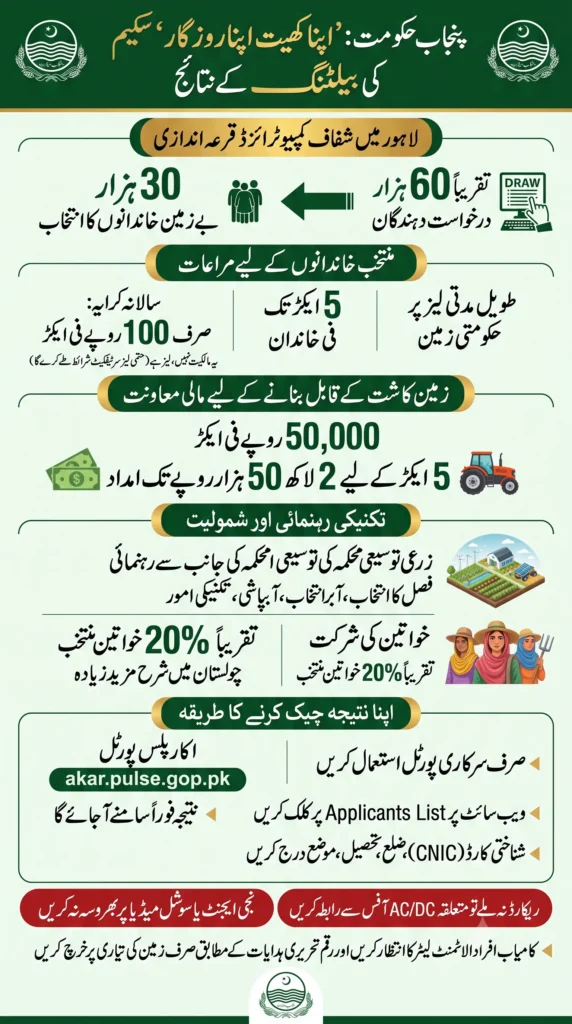
Apna Khet Apna Rozgar Scheme 2026 Balloting Result has been officially announced by the Punjab Government. 30,000 landless families selected out of nearly 60,000 applicants through transparent computerized balloting held in Lahore.
Winners receive up to 5 acres of state land on a long-term lease at just Rs. 100 per acre annually, plus Rs. 50,000 per acre in land-preparation support. To check your status, visit akar.pulse.gop.pk, click “Applicants List,” and enter your CNIC, District, Tehsil, and Moza for an instant eligibility result. This is a lease, not permanent ownership.
Quick Answer
The Punjab Government completed the computerized balloting for the Apna Khet Apna Rozgar (AKAR) Scheme in early July 2026, selecting 30,000 landless families out of roughly 60,000 applicants. Winners get state-owned agricultural land on a long lease, along with cash support to prepare it for farming. This is not free ownership — it’s a lease, and the paperwork matters more than the excitement.
Apply Now For Punjab E Bike Scheme.
What Exactly Is the Apna Khet Apna Rozgar Scheme?
Punjab has plenty of state-owned land sitting idle, and plenty of families who know farming inside out but own zero acres. The AKAR Scheme connects the two.
Instead of handing out one-time cash grants that get spent in a month, the government is leasing out cultivable land to landless households so they can build something that lasts — a real, recurring income from their own crop.
The scheme was rolled out earlier in 2026, applications closed by mid-May, and the balloting ceremony was held in Lahore in the first week of July, with the Chief Minister confirming that 30,000 families would benefit from the draw.
Here’s what the programme is really trying to fix:
- Landless families getting a genuine shot at agricultural income
- More cultivated land, which means more produce for Punjab
- A dent in rural poverty that doesn’t rely on handouts
- Real jobs, not seasonal daily-wage labour
- Better food security across the province
- Dignity — earning from your own crop instead of someone else’s field
Apna Khet Apna Rozgar Balloting Result 2026 — Key Numbers
| Detail | Information |
|---|---|
| Scheme Name | Apna Khet Apna Rozgar (AKAR) |
| Balloting Held | Early July 2026, Lahore |
| Selected Families | 30,000 |
| Total Applicants (approx.) | 60,000 |
| Land Offered | Up to 5 acres per family |
| Selection Method | Computerized, merit-based balloting |
| Lease Duration | Long-term lease (renewal clause applies) |
| Annual Lease Fee | Rs. 100 per acre |
| Land Preparation Support | Rs. 50,000 per acre |
| Max Support (5 acres) | Up to Rs. 250,000 |
| Women Beneficiaries | Around 20% of selected families |
| Official Portal | akar.pulse.gop.pk |
So What Does “Balloting Result” Actually Mean for You?
Here’s the thing people often get wrong — a ballot result is a selection, not a handover.
When more applicants applied for the same plot than there was land available, the system used a transparent computer draw to pick a name fairly. That’s what just happened for 30,000 families.
But your name showing up on the list is step one, not the finish line. The actual lease certificate, land verification, and legal handover still need to happen through your district office. Treat the ballot result as good news, not a land title.
How to Check Apna Khet Apna Rozgar Scheme Application Status
Don’t trust random WhatsApp forwards or Facebook pages claiming to have “the real list.” Stick to the official portal only, and the process itself takes barely a minute.
Step 1: Visit the official AKAR portal Go directly to akar.pulse.gop.pk — not a copycat site with a similar-sounding name.
Step 2: Click on “Applicants List” On the homepage, look for the Applicants List option and open it.
Step 3: Select your CNIC number, District, Tehsil, and Moza Fill in your ID Card number along with your District, Tehsil, and Moza exactly as you entered them during registration.
Step 4: Get your result instantly The moment you submit these details, the portal will show you straight away whether you’ve been selected or not — no waiting, no SMS delay.
If something looks wrong: If your CNIC doesn’t pull up any record, or your details don’t match, don’t go looking for a “fixer.” Head to the Assistant Commissioner or Deputy Commissioner office in your district — that’s the only legitimate place to sort out a discrepancy.
A golden rule worth repeating: no genuine government scheme ever asks you to pay someone privately to “confirm” your selection. If anyone does, walk away.
What Successful Families Actually Receive
Getting selected sets off a package of benefits, not just the land itself:
- Cultivable state land — typically up to 5 acres, depending on what’s available in your area
- A long-term lease, not permanent ownership
- Rs. 100 per acre as an annual lease fee — genuinely token money
- Rs. 50,000 per acre for getting the land farming-ready
- Technical guidance from the Agriculture Extension Department on crops, irrigation, and inputs
So a family allotted four acres could see around Rs. 200,000 in preparation support, and a five-acre allottee could get up to Rs. 250,000. That money is meant for things like levelling the land, buying seed and fertiliser, and setting up irrigation — not for anything else. Wait for written instructions before spending a single rupee of it.
Who Was Eligible in the First Place?
Applications have already closed, but here’s a recap for context, since a lot of people are still searching this even after the draw:
- Families with no agricultural land of their own
- Households without a stable, steady income
- People already connected to farming or agricultural labour
- Landless individuals wanting a genuine shot at self-employment
- Punjab’s most financially stretched rural households
Priority went to genuinely landless families rather than farmers who already owned property. Women were part of the process too, making up roughly a fifth of those selected — with an even higher share reported in the Cholistan region specifically.
If someone tells you fresh applications are open right now, verify it on the official portal first. There’s no confirmed new application window at this stage.
Your Name Is on the List — Now What?
Take a breath, then move methodically:
- Confirm your status on the official portal and save proof (screenshots, SMS, application number)
- Wait for your allotment letter and instructions from your district committee
- Talk to Agriculture Extension staff before choosing a crop — soil type, water access, and season all affect what will actually grow well on your plot
- Keep records of everything — every document, receipt, and farm visit, in case you need to reference it later
A rushed crop decision in the first season can waste a big chunk of that preparation money, so it’s worth the extra week of asking questions before you plant anything.
Didn’t See Your Name? Now What to do?
SMS and portal updates can lag behind a huge balloting exercise like this one — thousands of records don’t process instantly.
- Recheck your dashboard after a few days
- Use password recovery if you’re locked out
- If your status still looks wrong, go to your district Agriculture Department office with your CNIC and application details in hand
And again — anyone offering to “fix” your result for a fee is not part of any legitimate process.
Frequently Asked Questions
How do I check my Apna Khet Apna Rozgar Scheme Result 2026? Log in to the official AKAR portal using your registered CNIC and password, then check your application dashboard for your status.
How many families were selected in the AKAR balloting? 30,000 families were selected out of around 60,000 total applicants, through a computerized draw held in Lahore in early July 2026.
How much land does a selected family get? Generally up to 5 acres of cultivable state land, depending on plot availability in that district.
Do I now own this land permanently? No. This is a long-term lease arrangement, not private ownership or a sale deed. Your lease certificate will spell out the exact terms.
How much financial support will I receive? Rs. 50,000 per acre for land preparation, meaning up to Rs. 250,000 for a five-acre allotment.
When will I get my lease certificate? Allotment letters and land-position details are expected to follow shortly after the balloting, through your district administration.
Can women apply for or benefit from this scheme? Yes — women were part of the selection, making up roughly 20% of those chosen overall, with a higher share in some regions like Cholistan.
Final Thoughts
For 30,000 Punjab families, this balloting result isn’t just an announcement — it’s a real shot at building income from their own hands instead of someone else’s land. The opportunity is genuine, but so is the responsibility that comes with it: verify everything through official channels, protect your CNIC and OTP, and treat every rupee of the preparation support as something to plan carefully, not spend quickly. The families who take the process seriously from here on are the ones who’ll actually turn this land into a livelihood.